01
Employee Mindset Continues
As an owner you must create targets, decide priorities and take responsibility for every commercial decision
Start right, generate prescriptions, control stock and build a profitable territory with a structured pharma business system
A franchise company can give you products, price list, monopoly rights and promotional inputs, but it cannot automatically build your targets, territory discipline, doctor productivity, inventory control, review system or growth plan
As an owner you must create targets, decide priorities and take responsibility for every commercial decision
Doctor lists, chemist mapping, product focus, stock, outstanding and review often remain scattered across memory, diaries and WhatsApp
Without weekly milestones and structured review, month-end sales become an outcome you observe instead of a number you actively manage
The organisation gives targets, priorities, review cycles and managerial guidance
You have to build that operating structure yourself and continuously correct the gap between target and actual performance
These announced modules help you move from basic setup to stronger control, profitability and systematic expansion
Existing members receive these announced updates inside the same course without purchasing the program again

Existing learner feedback

Existing client feedback

Pharma Business Consultant, Trainer, Educator and Pharma Marketing Practitioner
This course connects pharma field working with the business systems required when a professional becomes an independent PCD owner
Planning to enter PCD before investing capital
Preparing for entrepreneurship and ownership
Needing stronger targets, systems, stock control and conversion discipline
Join the program, complete Chapter 1 and the PCD Business Diagnostic Worksheet — if the program has not provided useful clarity, follow the stated refund conditions within the guarantee period
A practical business training program for MRs, pharma professionals and PCD owners
Yes, especially if you plan to start your own pharma business
Yes, if you want to audit products, doctor working, stock, commercial planning, targets, team or execution
Yes, dedicated chapters cover detailing, field working, communication and conversion
No, announced future growth updates are included for existing members
No, results depend on territory, products, capital, competition, execution and market conditions
9 chapters, future growth updates and practical business tools
If you are researching how to start a PCD pharma franchise in India, the important questions are not only which company to join. You also need clarity about PCD meaning, required documents, investment, monopoly rights, PTR and PTS, product selection, doctor conversion, stock rotation and actual profitability.
PCD stands for Propaganda Cum Distribution. In a PCD pharma franchise, a pharmaceutical company authorises a franchise partner to promote and distribute selected products in an agreed territory, often with territory or monopoly terms.
A practical sequence is to assess your territory, doctor potential and budget first; shortlist a suitable company and product range; verify commercial and monopoly terms; complete applicable licences and registrations; then launch doctor and chemist working with controlled inventory.
Commonly searched requirements include an applicable Drug Licence, GST registration, PAN, identity/address proof, bank details and a written franchise or monopoly agreement. Exact legal requirements can vary by business structure, state and activity, so verify them with the relevant authority or qualified professional before starting.
There is no single correct investment figure. Capital depends on initial product range, minimum order quantity, territory size, promotional inputs, working capital, credit cycle and stock level. A safer approach is to calculate required working capital product-by-product instead of choosing a franchise only because its opening order looks cheap.
Monopoly or exclusive territory rights define where a franchise partner may market the company's products. Before paying, check the territory in writing, product coverage, performance conditions, renewal terms and what happens if another partner or channel operates in the same market.
Headline margin alone does not equal net profit. Understand net rate, PTS, PTR, MRP, GST, schemes, doctor-promotion cost, travel, credit, expiry and inventory turnover. Real ROI depends on how much capital is blocked and how consistently prescriptions convert into repeat secondary sales.
Do not select a company only from a “top 10” list. Compare product quality and manufacturing credentials, portfolio relevance, pricing, monopoly agreement, MOQ, supply reliability, expiry/return policy, promotional support and the company's ability to support your chosen territory.
General, derma, gynae, paediatric, cardiac-diabetic, gastro, orthopaedic and other segments can all work in the right market. The better speciality is the one supported by your local doctor universe, prescription potential, competition, product differentiation and repeat-demand opportunity.
Visual aids, LBLs, product literature, samples, reminder cards and MR tools can support field execution, but material alone does not generate prescriptions. You need doctor segmentation, a clear detailing story, call frequency, chemist availability and follow-up discipline.
Build a doctor master list, identify hero brands, map chemists, set monthly and weekly targets, track doctor conversion, maintain stock availability and review prescription-to-order movement. Growth becomes more predictable when territory activity is measured rather than managed from memory.
Pharma PCD Mastery connects these topics into one operating system—from company and product selection to budgeting, territory planning, doctor conversion, stock control, profitability and expansion.
Join Pharma PCD Mastery →Your PCD problem is rarely one single thing. The course connects the decisions that actually run the territory — so you know what to fix, what to track and what to do next.
PCD business usually does not fail because of one single issue. Find where your system is breaking before putting more money into stock or promotion.
The goal is not only to understand PCD. It is to make the key decisions of your territory with more structure and less guesswork.
Learn to look beyond PTR/MRP and understand what remains after the real cost of running the territory.
Field execution cannot compensate for a weak supplier, unclear commercial terms or uncontrolled working capital. These checks belong inside the business system.
Product quality • Manufacturing/supply • Dispatch • Replacement policy • Commercial commitments • Monopoly compliance
Doctor selection • Brand focus • Detailing • Follow-up • Chemist coverage • Inventory planning • Credit • Targets • Review
Practical systems for the commercial situations that can quietly damage cash flow, stock movement and territory performance.
The exact loss differs by business. The point is to identify avoidable risk before money becomes blocked or lost.
Not only lessons. Use practical calculators, trackers, checklists, scripts and SOPs to turn learning into day-to-day business action.
Preview the Territory Potential Calculator and Real Profit Calculator in action. A short screen-recording can be placed here to show exactly what members receive.
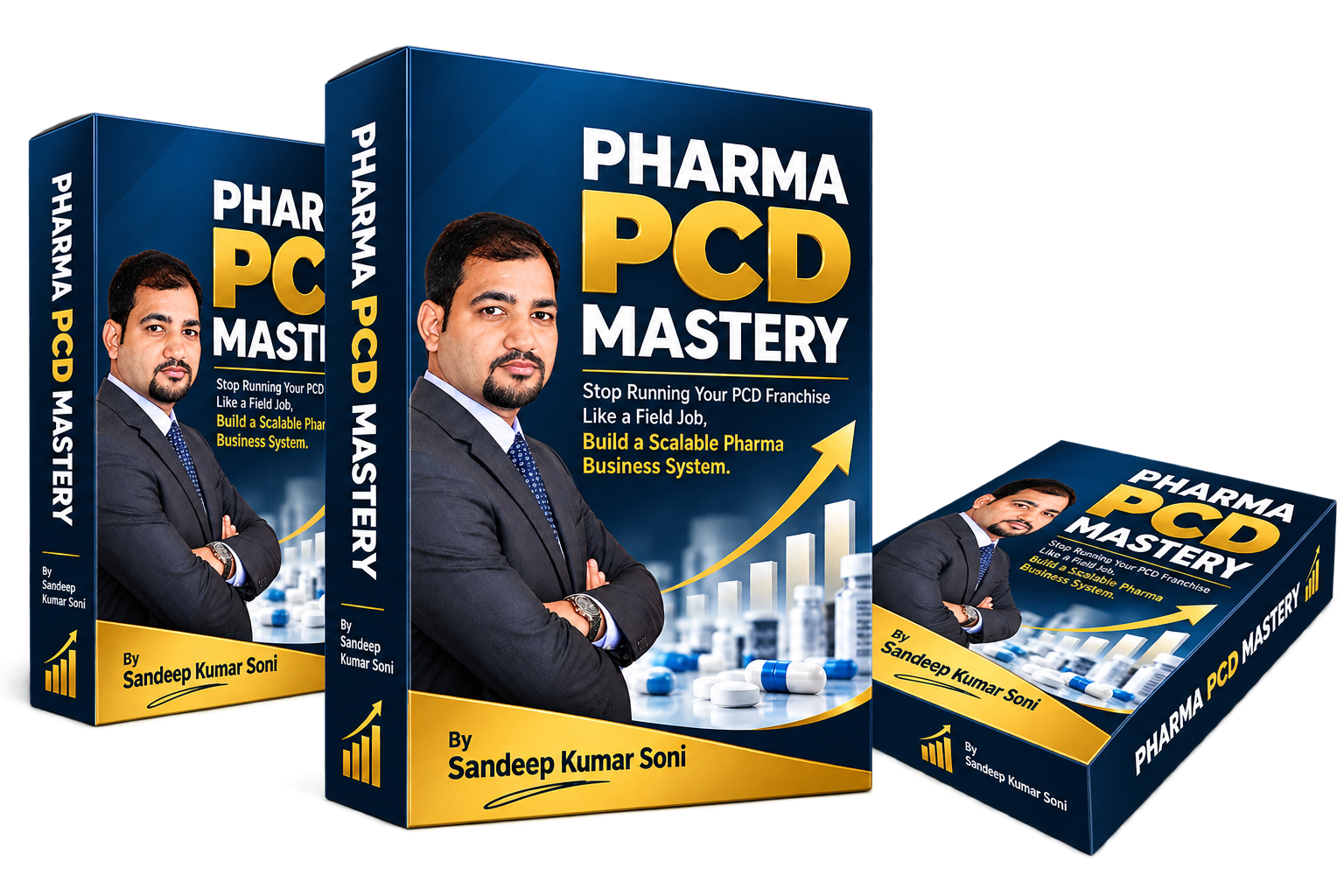
Not just PCD theory. By the end of the program, you should understand how the major business decisions connect—from selecting the opportunity to reviewing territory performance.
Training plus practical implementation resources designed to help you make better PCD business decisions.